

Resident Evil 4 Ps3 Frame Rate
Resident Evil 3 is Capcom's 2nd attempt to bring the classic-era Resident Evil titles to a new audience. Twenty years have passed, merely looking at the disquisitional reception, the Resident Evil 3 remake volition likely terminate up as underrated as its spiritual predecessor. While gameplay and environments might mark a bit of a stride back from the spectacular Resident Evil 2 remake, Capcom has put considerable effort into making the franchise'south latest iteration look nifty on current-gen platforms.
As the current console generation winds up, Resident Evil 3 is one of the terminal big AAA to exclusively arrive on eighth-gen platforms. While the game itself hasn't received critical acclaim, from a technical perspective, this is a very achieved title using toolsets Capcom's had an unabridged generation to perfect. Allow's have a deep swoop and discover out what makes Resident Evil 3 tick.
PC vs PS4 Pro vs Xbox One X Comparison, Performance and Resolution Parameters
Let'due south brainstorm with the best version, which is undoubtedly the PC version. The PC version is packed with a ton of graphical options including but not limited to Paradigm quality, Shadow Cache, Shadow Quality, Particle and Lighting quality, Texture quality and Texture filtering. The UI also shows an indication of how much memory is being used and the kind of effect each graphical option has. Resident Evil 3 on everything maxed out on the PC is a looker and nosotros had adjacent to no issues running this game at a rock solid 60fps.
At present, permit's talk about the console versions only earlier we proceed ahead we wanted to make a notation. On the console front, nosotros analyzed the game's performance by taking some sample scenes from the game and running it through trdrop, an open source software. Note that this tool gives the states a mere sit-in of the game'due south performance, because an exact one:ane representation of performance can merely be provided past the developers themselves since they have admission to vast of array of tools and profilers. Also note that this analysis only considers the campaign mode.
While Resident Evil 3 looks corking on the two enhanced consoles, performance and the overall experience are surprisingly different on the Xbox Ane X and PlayStation four Pro. Both of the top-end console versions make utilise of checkerboard rendering. This means that we're not getting a total native output. Upwardly shut, checkerboarding artifacts are evident, especially on transparencies such on fences. The large differences here, though, are in terms of output resolution and overall operation.
The Xbox 1 X version of the game runs at 2160p with checkerboarding. Meanwhile the PS4 Pro goes for a more conservative 1620p with checkerboarding. In many cases, this is a fairly standard resolution delta between these two platforms and we'd expect performance parity. Notwithstanding, the 4K checkerboarded output proves to be a bit too much for the Xbox One X to handle. Nosotros noticed essentially worse performance on Microsoft'due south console. Nosotros suspect that Capcom wanted to do 4K on the Xbox One X at all costs and compromised here on operation.
This leads to an unusual situation where the PlayStation four Pro actually delivers the best overall panel experience, with framerates in the l-60 FPS range. We practise take consequence with Capcom's decisions to fully unlock the framerate on console. The Xbox One 10 version in particular suffers from serious dips from scene to scene that accept a tangible touch on on responsiveness. Even the 50-60 FPS output on the PlayStation iv Pro is inconsistent and stutter-prone. Capcom actually should have dropped the resolution to 1800p checkerboarded on the Xbox One X. Information technology'll be interesting to see if they offer this option in a future patch to address functioning issues.
Engine Overview

Resident Evil 3 is built on the aforementioned core engineering science every bit Resident Evil 2, Capcom's new RE Engine. The RE engine is the eighth-gen successor to Capcom's MT Framework and bakes in a number of advanced rendering features including subsurface handful shaders, shadow caching, and a fully dynamic lighting system. The RE Engine was outset deployed in Resident Evil: 7 and was since used in Resident Evil 2. Dissimilar the MT Framework, the RE Engine uses fully deferred rendering. This is a fundamental point of difference because it'south what allowed Capcom to deploy so many dynamic lights in Resident Evil 3 scenes.
The effect is particularly pronounced in Raccoon City exteriors where emissive neon lights breast-stroke the environs and characters in a number of different colors. Particle furnishings like barrel explosions also emit lit. For performance reasons, though, the number of shadow casting lights is quite express. Jill's flashlight, all the same, casts shadows on objects, likewise as number of signal-light sources. The RE engine in Resident Evil 3 utilizes a physically based material rendering pipeline. This is something we saw in Resident Evil 2 and Capcom's artists take connected their excellent material piece of work here.
Surfaces like cobblestone, textile, and metallic are rendered physically correctly. The movement to a deferred renderer has also had an touch on on how anti-aliasing is handled. Instead of the MSAA used in MT Framework titles, RE Engin in Resident Evil 3 goes for post-process temporal AA solution. It does a great task with covering aliasing, but introduces a pregnant amount of blur in the process. PC owners take the choice to deploy post-process sharpening tools but console owners, specially those on the PS4 Pro with its 1620p ouput, will have to put up with sub-par image quality.
Character and level design
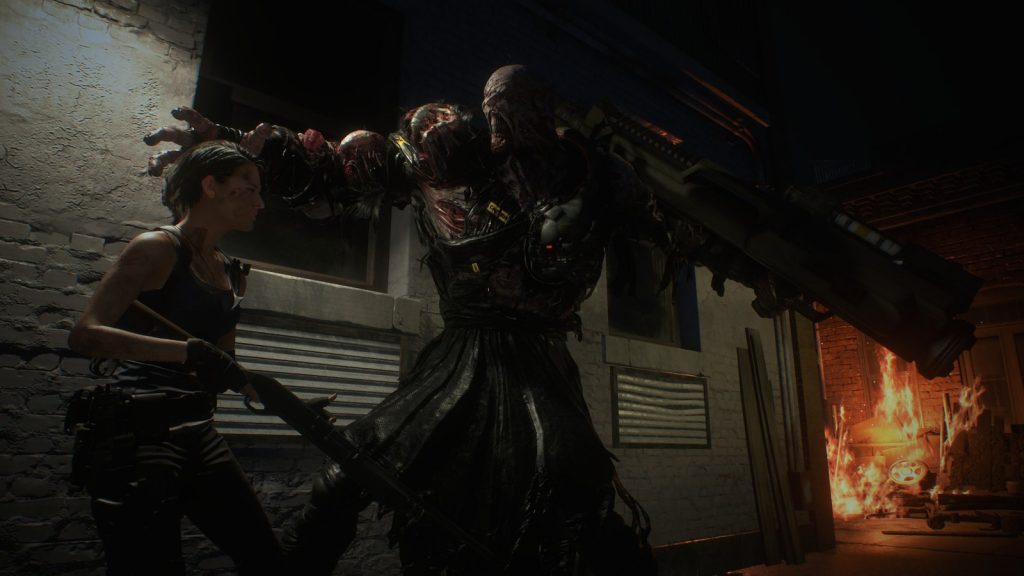
The original Resident Evil 3 delivered excellent grapheme models for the fourth dimension. Information technology did so on fifth-gen console hardware by using pre-rendered environments, assuasive the developer to allocate the entire polygon upkeep to the models themselves. In the eighth-gen, this is no longer an upshot.
Character models for main characters like Jill, Carlos, and of form, the Nemesis, have very high poly counts in the mid-five digits. High frequency details likle the rivets on Jill's satchels and holster are fully modeled. Animated polygonal hair is besides deployed. The temporal AA solution smooths over the pilus for a surprisingly clean presentation.
Relative to Resident Evil 2, the biggest technical modify in Resident Evil iii is the move to wider open environments in and effectually Racoon Urban center. While external areas are still relatively linear, specially compared to titles like The Evil Within 2, Resident Evil 3 opens up the surround considerable compared to the earlier Remake championship.
This is especially important in an early on-game chase scene with the Nemesis in hot pursuit. In certain outside areas, such equally outside the Moon Donut store, it'southward evident that Capcom's implemented generous LOD scaline. This minimizes pop-in, even on the base consoles leading to a very consistent experience. While not open world in any respect, the RE Engine handles Resident Evil 3'southward wider outdoor environments with ease, and looks nifty while doing so.
Particle and Mail-Process furnishings
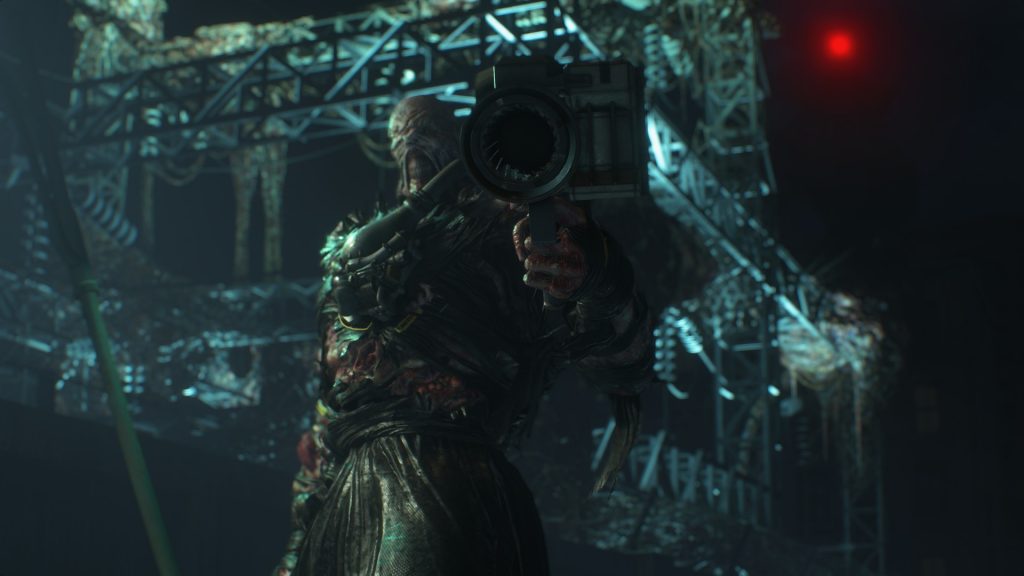
The move to a deferred renderer with the RE Engine has proved to be a major boon when it comes to Resident Evil iii's particle rendering. Blastoff effects such as the fire from barrel explosions appear to exist rendered at full res, fifty-fifty on consoles. Volumetric effects similar fog and the high quality grit issue in the subway train create an illusion of depth, even if they aren't actually lit by other lite sources. Many particle furnishings in the game, from gunshots to explosions emit light, simply don't actually cast shadows. This is, as mentioned earlier, likely for operation reasons.
The game also has a reasonably accomplished post-process rendering pipeline. As mentioned earlier, nosotros're looking at a temporal anti-aliasing solution here with excellent coverage. While image quality tends to be on the softer side regardless of platform, aliasing is handled well, even on base consoles that render in at a lower resolution.
We run into a number of other postal service-procedure effects deployed besides: Chromatic abnormality is in play, besides equally a loftier-quality per-object motion blur. Depth of field in cinematics, though, is of middling quality. The game does feature ambient occlusion, but the SSAO implementation on consoles doesn't have the all-time coverage.
Comparison the Remake with the Original Resident Evil three
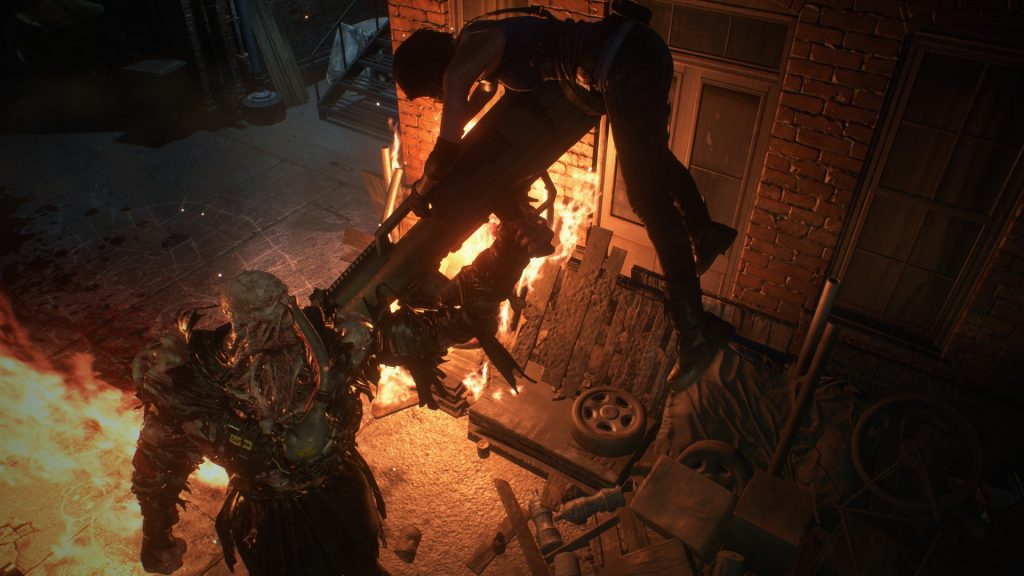
A common critical complaint has been that the Resident Evil 3 remake has fiddling to do with the original game, apart from sharing a common narrative, with the remake fifty-fifty omitting a number of key set locations. That being said, this is an incredible-looking game and an splendid showcase of just how far rendering applied science has come in the xx years since the original Resident Evil three. It's interesting to note that the existent-fourth dimension environments in the Remake wait substantially better than even the pre-rendered backgrounds in the original.
A lot has changed in twenty years. All aspects of rendering are now in realtime. The original was built with 480p avails in heed: some versions like the PlayStation 1 iteration actually operated beneath that, circa 320p. In terms of asset quality, nosotros're looking at something like a 15x increase in fidelity when comparing the game's 480p output to the Xbox Ane X's superlative-end 4K.
The other change is, of grade, the move to a more conventional tertiary-person activity setup, as opposed to the tank controls and fixed camera angles of the original Resident Evil three. Raccoon City has never looked every bit skillful as does now, arguably even when compared to the Resident Evil CGI movies.
Decision

Regardless of the platform y'all play on, Resident Evil iii is a great late-gen showcase for Capcom's RE Engine. It'due south accomplished lighting organisation and excellent character and ecology modeling create a peachy-looking–and frankly terrifying environment to play in. While purists might take effect with the game's linear nature, it'southward a corking introduction to the early Resident Evil franchise for a new generation.
Our only real complaint is with regards to inconsistent functioning, thanks to a puzzling resolution on the Xbox 1 X and an unlocked framerate. Apart from that, this is a slap-up 8-gen swansong. We await forward to seeing what Capcom will exercise on the Xbox Series X and PlayStation v next year.
Source: https://gamingbolt.com/resident-evil-3-remake-xbox-one-x-vs-pc-vs-ps4-pro-frame-rate-analysis-and-more
0 Response to "Resident Evil 4 Ps3 Frame Rate"
Post a Comment